Risk Screening
Manage exposure across a broad range of environmental and economic factors including transition risk, physical risk and nature risk.
Identify, Quantify and Strategize
Riise delivers a robust, integrated approach to climate and nature risk screening, enabling companies to identify, quantify, and strategically manage exposure across a broad range of environmental and economic factors.
Screening for likely material risks
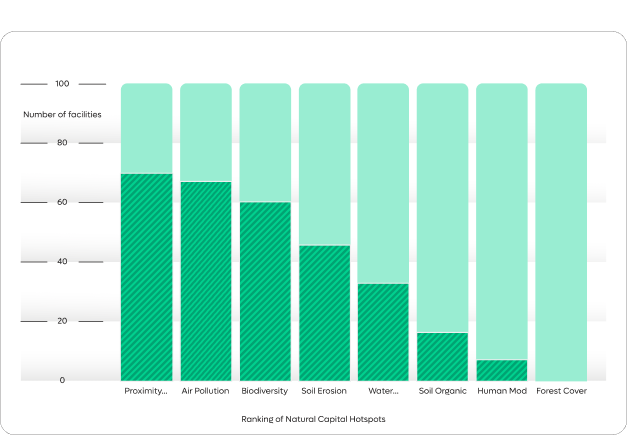
Screen for likely risks across the company’s facilities by visualising Very High and High (Hotspot) locations by region, producion process type and State of Nature dataset.

Understand Exposure to Physical Climate Risks
Assess physical climate risks with granularity and strategic relevance to support resilience across global operations, supply chains, and asset portfolios.

Climate
Acute Physical Risks
Riise quantifies exposure to high-impact climate events; floods, wildfires, droughts, and severe storms, at an asset and supply chain level. This includes evaluating the operational implications of business interruption, infrastructure impairment, and supply constraints related to raw material volatility.

Climate
Chronic Physical Risks
Riise models the long-term trajectory of climate change, incorporating variables such as increasing mean temperatures and shifting precipitation patterns. These insights inform strategic decisions related to agriculture, water management, energy consumption, and the long-term viability of physical assets in specific geographies.
Understanding Impacts to Sensitive Areas of Nature
Recognizing the systemic relationship between climate and natural capital, Riise expands its screening capabilities to capture nature-related dependencies and risks across the value chain.
nature
Nature-Related Financial Risks
Riise helps businesses identify where operations depend on ecosystems such as clean water or fertile soil, or impact these systems as a result of pollution. Riise financially quantifies these exposures, both physical (ecosystem collapse) and transition (regulation, market trends, reputational exposure).
nature
TNFD-Aligned Methodology
The Riise platform is structured around the Taskforce on Nature-related Financial Disclosures (TNFD) framework. We guide organisations through the LEAP process (Locate, Evaluate, Assess, Prepare) for nature-related impacts, dependencies, and opportunities.
nature
Double Materiality Perspective
Riise supports double materiality assessments capturing both the company’s impact on nature and how changes in nature affect the company financially. This dual lens enables better informed strategic planning and disclosure.
nature
Supply Chain Dependencies
Organizations can map and measure critical dependencies on natural capital across land use, water withdrawal and raw material sourcing to identify concentration risks and build operational resilience across the value chain.
Understand Macroeconomic Shifts That Will Drive Emissions Trajectories
Macroeconomic and emissions modeling ensures companies can anticipate systemic changes as economies transition towards the net-positive economy.
Macroeconomic Transition Risk Analysis
Leveraging NGFS-aligned climate pathways, Riise simulates how global economic conditions could shift under different climate scenarios, supporting forward-looking risk management and opportunity identification. This includes:
Policy and regulatory dynamics
Evaluate how climate-related policy, such as carbon pricing or emissions regulation, could impact cost structures, market access and compliance obligations across jurisdictions and sectors.
Explore the Benefits of the Riise Platform
Riise Benefit
Digital Twin Insights
a dynamic and interconnected view of business performance equipping companies to evaluate climate- and-nature-related risks and opportunities across operations, portfolios, and the full value chain.
Riise Benefit
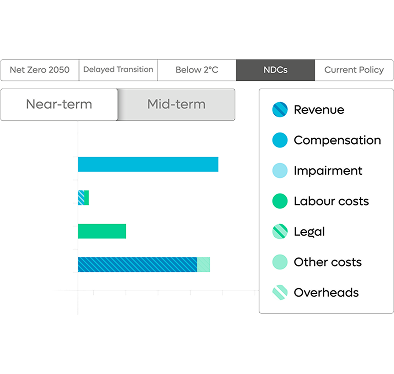
Financially Quantified Scenario Analysis
Translate climate uncertainty into actionable financial intelligence.
Riise Benefit
Transition and Mitigation Planning
Build a commercially robust business case for emissions reduction through strategic transition planning.