
Quantifying the Business Impact of Global Water Stress
Water stress is one of the most pressing threats to business continuity and presents risk across all sectors.
Why is Water Stress a Business Continuity Issue?
Access to water is a critical systemic issue that can impact the costs and viability of corporate operations. A shortfall of water directly impacts production processes, hinders agricultural productivity, and disrupts supply chain logistics.
Investors, regulators and lenders increasingly view water risk as material to business and expect companies to disclose water-stress strategies to mitigate financial risk:
- In Europe, the Corporate Sustainability Reporting Directive (CSRD) requires companies to conduct a Double Materiality Assessment to identify how their business impacts water systems (Impact Materiality) and how water scarcity/pricing impacts corporate finances (Financial Materiality). Organizations in scope are mandated to isolate and report quantitative water data specifically for sites, operations, or supply chains located in areas of high water stress.
- Under the International Sustainability Standard Board (ISSB) frameworks, disclosing material environmental risks to enterprise value is mandatory, effectively establishing water risk as a core element of mainstream financial reporting.
What Makes Water Risk Unique Compared to Other Operational Threats?
Unlike many other raw materials, water is an unsubstitutable asset with zero viable alternatives, creating a profound risk to business continuity. This absolute dependency spans many sectors: from agricultural production, where soil moisture determines crop yields; to the apparel sector’s fabric dyeing and finishing processes; to pharmaceutical Active Pharmaceutical Ingredient (API) production relying on high-purity process water. Simply put: if the water supply stops, the business stops.
Water is also critical in the use-phase of many products, and so downstream market demand can be affected by lack of local water availability and poor water quality. Severe regional water stress can suppress consumer demand for water-reliant products, requiring a shift in a company’s product portfolio.
For example, personal and household products, whose everyday use requires water, face losing sales in regions affected by water shortages if local consumers can’t use them. Similarly, appliance manufacturers are experiencing shifting demand away from legacy washing machines toward smart, ultra-low-water, and even greywater recycling models.
How Does Water Stress Trigger Global Supply Chain Disruptions?
Water stress triggers global supply chain disruptions through a combination of raw material yield collapses, geographical concentration bottlenecks, and cascading facility-level operational halts. Because supply chains often rely on highly concentrated geographic regions for specific inputs, local water depletion creates global systemic bottlenecks.
When a critical, unsubstitutable raw material is sourced from a “very high” water-stress grid cell, any local water disruption immediately halts the entire downstream global product line. A prime example occurred in 2021 during Taiwan’s worst drought in over 50 years. The island produces roughly 90% of the world’s most advanced microchips, a manufacturing process that relies heavily on millions of gallons of ultrapure water daily to clean silicon wafers. As reservoirs dried up, the Taiwanese government was forced to ration water and prioritize chip fabrication over agriculture, while manufacturers like TSMC had to actively truck in water via fleets of tankers just to keep production running. The physical water shortage compounded the pandemic-era global chip crisis, directly stalling production and delaying assembly lines for automotive and consumer electronics manufacturers worldwide.
Companies planning new facilities or expanding their existing footprints increasingly find that local water scarcity creates insurmountable permitting and legal barriers. For example, data centres, electric vehicles, and battery manufacturing are incredibly water-intensive operations; new facilities have faced fierce local opposition and legal challenges where water withdrawals threaten municipal reserves. Fearing aquifer depletion, policymakers in states like New York have floated or enacted data center moratoriums, while European hubs are enacting strict closed-loop cooling mandates, slowing digital and green technology expansion.
Why is it Important to Translate Physical Water Risk into Financial Metrics?
Translating environmental dependencies like water stress into financial metrics is the single most critical step in managing corporate climate and nature risk. Without financial quantification, corporate boards cannot justify investments, risk teams cannot prioritize resources, and companies cannot fulfil stringent double-materiality disclosure mandates. Critically, quantifying the financial dependencies, impacts, and risks related to water translates complex environmental data into the language of enterprise risk management for the Chief Risk Officer and CFO.
Risilience Water Stress Assessment
Pinpoint how water stress threatens revenue at key production sites with a Risilience Water Stress Assessment consultancy sprint.
Will the Cost of Water Rise?
Water will likely become a material regulatory cost, with intensive basin-level management and access-right negotiations emerging as the standard path forward, mirroring frameworks in highly stressed agricultural and industrial hubs like Australia’s Murray–Darling Basin and California under the Sustainable Groundwater Management Act (SGMA).
The administrative and physical burden of defining, monitoring, and allocating access rights will increasingly be transferred directly to commercial users via extraction levies, infrastructure assessments, and volatile water market pricing. Businesses that fail to proactively engage with watershed governance and reduce water intensity risk severe financial shocks, asset stranding, and the loss of their legal and social license to operate in critical basins. This dynamic is already unfolding in groundwater-stressed parts of India, where industrial users such as beverage bottlers have faced regulatory extraction curbs under the Central Ground Water Authority (CGWA), severe community backlash, and plant closures due to perceived resource competition.
Beyond complex access rights, governments and water authorities are increasingly enacting conservation mandates, such as tiered volumetric pricing, required wastewater recycling, and mandatory efficiency caps, specifically designed to internalize the true cost of water and compel heavy consumers to curtail consumption – an exposure quantified in CDP’s Global Water Security Analysis.
For water-intensive companies, treating water as an unpriced utility is no longer financially viable. Integrating watershed-level analytics and internal shadow water pricing into capital allocation decisions is becoming essential to de-risk balance sheets and safeguard operational continuity against tightening basin constraints.
How Can Companies Get Ahead of Disruptions from Water Stress?
Companies can proactively get ahead of disruptions from water stress by taking strategic, system-driven actions that transition an organization from reactive crisis management to proactive risk mitigation and capital protection.
Risilience quantifies nature-related dependencies and risks into investor-grade financial metrics (Earnings Value at Risk) to drive both strategic corporate decision-making and seamless compliance. Risilience bridges the gap between environmental science and the corporate balance sheet:
- We map acute water and drought risks across an organization’s raw material sourcing, processing, and distribution networks.
- Our global water pricing model converts these physical risks into a dashboard of clear financial metrics.
- Just as companies use internal shadow carbon pricing to prepare for carbon taxes, our model establishes shadow water pricing pathways to protect long-term Enterprise Value at Risk.
- These metrics provide the business case needed to establish internal water pricing and resilient sourcing policies.
Water Risk Resources
Equip your team with actionable water stress strategies to safeguard critical supply chains and turn environmental compliance into a measurable business advantage.

Get The Essential Guide to Water Stress to understand why water scarcity is a problem and how to quantify your risk before the supply stops.
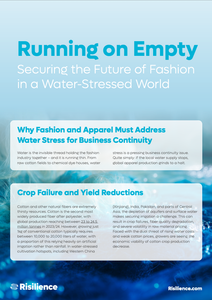
Find out why fashion and apparel companies must address water stress now to secure the future of fashion in a water-stressed world.
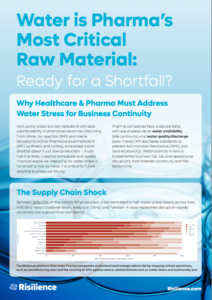
Discover five climate-ready strategies to protect healthcare and pharma supply chains and enterprise value against water stress.