
Everything You Need to Know About El Niño 2026
Findings From the El Niño 2026: Risilience Scenario Analysis
The looming threat of a Super El Niño this summer will add to the pressures on the agricultural industry already stressed by fertiliser shortages, inflation, and oil price hikes by adding a further systemic shock to the cost of consumers’ shopping baskets.
Up to $342.2 Bn in Lost Production Value
Under an “Extreme El Niño” scenario, global agricultural production could drop by 14.3%, resulting in an estimated $342.2 billion in lost production value (at 2025 prices).
Up to 100% Consumer Price Surges
We could see simultaneous price shocks of 10% to 50% across major food crops, with the most severely impacted commodities (like rice, palm oil, sugar cane, and coffee) potentially surging by 50% to 100%
Up to 60% of Global Calories at Risk
Just four crops—wheat, rice, maize, and soybeans—account for over 60% of all global calories, meaning a correlated weather failure across multiple continents threatens the core of the world’s food supply.
Don’t just take our word for it. El Niño and the Risilience Scenario Analysis have been featured in global news and media.

An El Niño ‘Godzilla’ is coming, and global food supplies could be in danger

Super El Niño poses critical threat to 500 million of the world’s farmers

The US Food Imports Most at Risk From Super El Niño This Summer
What is a Super El Niño and why is 2026 a Concern?
El Niños are a routine part of our weather cycle – on average every seven years the trade winds weaken allowing a warmer current to flow east in the Pacific Ocean affecting the weather worldwide. Over the past century they have caused minor fluctuations in food production in multiple agricultural regions, from China to Latin America.
Once in a while, a more severe version of el Niño causes wildfires, storms and significant food production shortages in more parts of the world. The weather forecasters are worried: the signals they are picking up now suggest that the el Niño that is developing could be a particularly strong one, attracting media headlines as ‘Super’, ‘Supercharged’ and even ‘Godzilla el Niño’.ccess to water is a critical systemic issue that can impact the costs and viability of corporate operations.
Key Impacts of the Looming El Niño
Three reasons why the possibility of an extreme El Niño must be taken seriously:
- Widespread Economic Disruption: We are getting used to weather events being record breakers, but this one could reduce the profitability of food producers, restaurants, supermarkets, farmers, and hit the pockets of shoppers particularly hard. Politicians know that food prices cause mood changes in the electorate. It is not too far-fetched to be concerned about political fallout from the impact on our agro-economy caused by the looming el Niño.
- Simultaneous Commodity Price Shocks: Scenarios for how this year’s el Niño could play out could see price shocks of 10 to 50% for many of the major crops of the food industry, varying from crop to crop. The key take-away is that price shocks will be felt across many of the core items in the consumer’s shopping basket at the same time. Historically we have seen price shocks to individual commodities, but rarely across all of them.
- Systemic Risk to Global Supply Chains: In today’s climate reality, a single large-scale climate event, such as the coming Super El Niño, will trigger correlated failures across different continents and commodities, creating systemic risks that makes traditional geographic diversification more difficult. For a company that has proactively invested in building climate resilience, the crisis unfolds in a fundamentally different way.
How El Niño May Play Out in 2026 and 2027
The weather patterns being predicted include hotter temperatures over key food production regions including China, India, Australia, Latin America and the Pacific Northwest and upper Midwest of North America. Forecasts include droughts and lengthy periods of below-average rainfall in swathes of southeast Asia, Central America, and potentially a failure of the monsoon rainfalls of the Indian subcontinent.
Weather anomalies are expected from July onwards, strengthening over the later summer and early fall, to be making headlines throughout the winter and new year and into the key growing seasons of spring in the northern hemisphere. The effects could persist into 2027 and 2028.
Quantifying the Potential Impact on Global Food Systems
Risilience has combined forecast data for the likely El Niño weather patterns with its models of agricultural science and market dynamics. We group the likely outcomes into three scenarios:
- Scenario 1: Super El Niño (similar to 1982/83 or 1997/98): Sea surface temperatures above 2°C.
- Scenario 2: Severe El Niño (similar to 1877/78): Sea surface temperatures of over 3°C.
- Scenario 3: Extreme El Niño with Northern Hemisphere Heatwave: Sea surface temperatures could exceed 4°C and last through a second growing season.
|
|
Impact on Global Agricultural Production (Tonnes) |
Value of Lost Production (at 2025 prices) |
|---|---|---|
|
S1 Super el Niño – 1982/83 or 1997/98 |
-3.7% |
$77.5 Bn |
|
S2 Severe el Niño – 1877 |
-9.1% |
$192.9 Bn |
|
S3 Extreme el Niño with Northern Hemisphere Heatwave |
-14.3% |
$342.2 Bn |
Get an El Niño Impacts Report
Model production losses and margin impacts for your specific raw materials. Get targeted, strategic recommendations for material substitution (if relevant) and guidance on potential strategic initiatives to secure supply continuity and hedge against predicted price spikes.
Global Consequences of Localized Impacts
Global food production is a complex system. While it consists of thousands of crop types, the bulk of its value is in around 50 primary source crops. Just four – wheat, rice, maize and soybeans – account for over 60% of global calories.
When a global event like an El Niño occurs, the simultaneous impacts of weather anomalies in multiple parts of the globe – the ‘teleconnections’ – cause a correlated shortfall of production across multiple markets. This causes the shortages and price increases that consumers will see in their weekly shop.
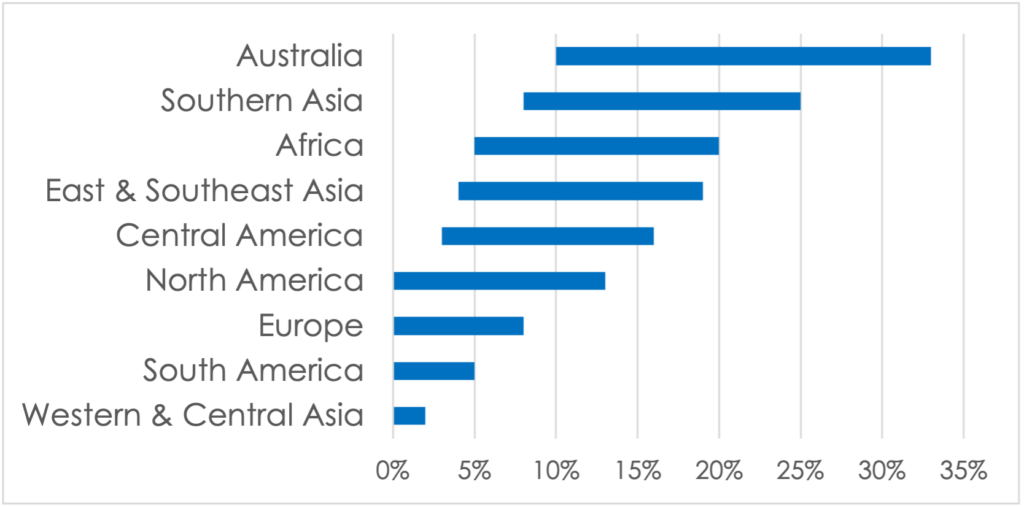
Which Foodstuffs/Crops are Most at Risk?
Some of the crops most at risk include rice, palm oil, sugar cane, wheat, coffee, cocoa, and potatoes. Shortfalls in crops that feed livestock, like soybeans, could cause longer-term impacts on the cost of meat and dairy.
- Heatwaves Ruin Harvests: Higher temperatures and reduced rainfall cause heat stress in plants, stunting growth and affecting yields.
- Livestock Out of Their Comfort Zones: Increased temperatures affect livestock farming. Cattle suffer from heat stress, and dairy cows can see a 10% reduction in milk production from a single day of heat stress.
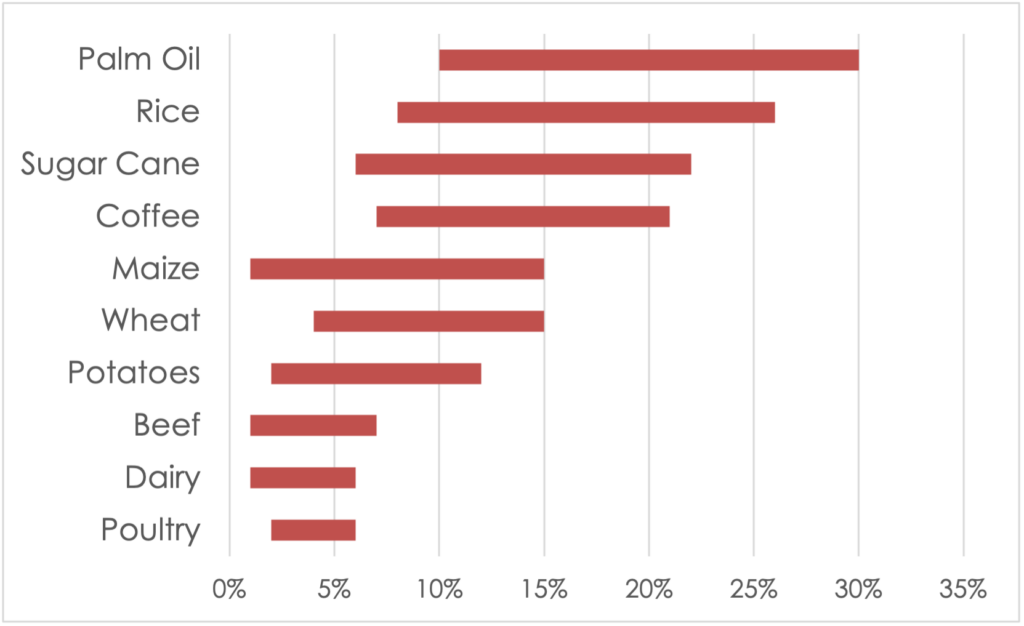
Will El Niño Trigger Food Price Hikes?
A seemingly small drop in global supply can trigger disproportionately large price spikes, amplified by market panic, speculative trading, and government interventions. Some of the more severe forecasts imply levels of production shortfall that could push prices of some crops up by 50-100%. Some of the most impacted crops, such as rice, palm oil, sugar cane, and coffee could see significantly higher price surges.
The Resilience Dividend: Your Competitive Advantage
The business challenge has shifted from simply enduring disruption to developing a business model prepared for permanent volatility. Forward-looking companies are developing strategies to improve the security of their agricultural supplies and minimise future cost shocks.
Geographical Diversification and Resilient Agriculture
Building supply chain resilience involves a strategic balance between two complementary approaches: diversifying to de-risk and investing in resilient agriculture. This means reducing dependence on exposed commodities, building partnerships with growers, and investing in adaptation measures at the source.
World-leading brands are already proving the ROI of co-investing in agricultural resilience:
- Securing yields through crop innovation: In Côte d’Ivoire, rising temperatures and erratic rainfall severely threaten coffee production. To combat this, Nestlé recently completed a multi-year research project evaluating robusta coffee varieties. They found that planting a validated mix of six specific varieties boosted yields by up to 86% while significantly enhancing drought tolerance. Through the Nescafé Plan, these resilient varieties are now being distributed to local farming cooperatives, securing Nestlé’s future supply chain.
- Scaling regenerative agriculture: Unilever is integrating regenerative agriculture across deeply exposed supply chains, including soy, palm oil, rice, and tea. Initial pilots across eleven countries have already delivered positive impacts on yield stability, water management, and emissions reduction.
Where unprepared companies face catastrophic disruption, a resilient food industry has the tools to weather the storm and even strengthen its competitive position. Improving the food industry business model for reduced volatility of supply and improving the predictability of cost will require adapting current practices so that future El Niños can be managed without crisis. The first step to mitigate risk is to understand the impact of El Niño. Learn more about the El Niño Impacts Report.
El Niño Resources
Equip your team with actionable El Niño mitigation strategies to safeguard critical supply chains and turn climate risk management into a measurable business advantage.
Risilience Resource
Future-Proofing Food Supply Chains Against El Niño Shocks
Uncover how sourcing diversification and climate-resilient agriculture investments deliver quantifiable supply security within three to ten years in the Cultivating Agricultural Resilience whitepaper.
REPORT DOWNLOAD
Act Now to Protect Value: Navigating the 2026-2027 El Niño
Uncover how physical climate scenario modeling and proactive procurement hedging deliver quantifiable margin protection over the next 18 months in the El Niño 2026–2027 Report.