

Securing agriculture supply chains in the era of unpredictable supply
Food and Agriculture Companies Are Already Feeling Financial Shocks From Climate and Nature Risk – But the Real Disruption Has Barely Begun
Risilience considers the consequences for business and how advanced analytics help companies move beyond reactive crisis management to take a strategic approach that mitigates risk and builds resilience.
Global organizations are facing unprecedented raw material volatility driven by:
- Disrupted yields: climate extremes and ecosystem degradation are creating significant instability in crop yields across key global breadbaskets. Risilience modeling indicates that there is an estimated 30% reduction in food oil crop yields by 2050 in some growing regions, relative to 2025 production estimates. Food oil crops are essential for the production of most processed consumer food products and many personal care items.
- Extreme price volatility: commodity price spikes are becoming more frequent and severe, directly threatening profitability and production stability.
- Instability of supply: The convergence of climate change, ecosystem degradation, and geopolitical uncertainty is creating unprecedented systemic risk within the global food supply chain. More frequent and extreme climate events, compounded by the cumulative stress on nature, directly threaten the quantity and quality of crop yields. Furthermore, key supply hubs and transit zones are increasingly vulnerable to disruption. With risk escalating at every stage of the food value chain from farm to table, the potential for cascading failures poses a significant and growing threat.
The Solution: Turn Uncertainty into Strategic Advantage
Climate and nature risk in agricultural supply chains is a material financial issue that requires a sophisticated data-driven response. At Risilience, we support many leading food and agriculture organizations to move beyond reactive crisis management to take a proactive and strategic approach that builds resilience. Our advanced analytics platform, Riise, translates complex climate and nature risk into clear, financially quantified, and actionable strategy, designed to build strategic advantage.
How Risilience Mitigates Risk to Build Resilience
Identify and Quantify True Exposure and Optimal Growing Conditions
Understand what commodities are at risk and why
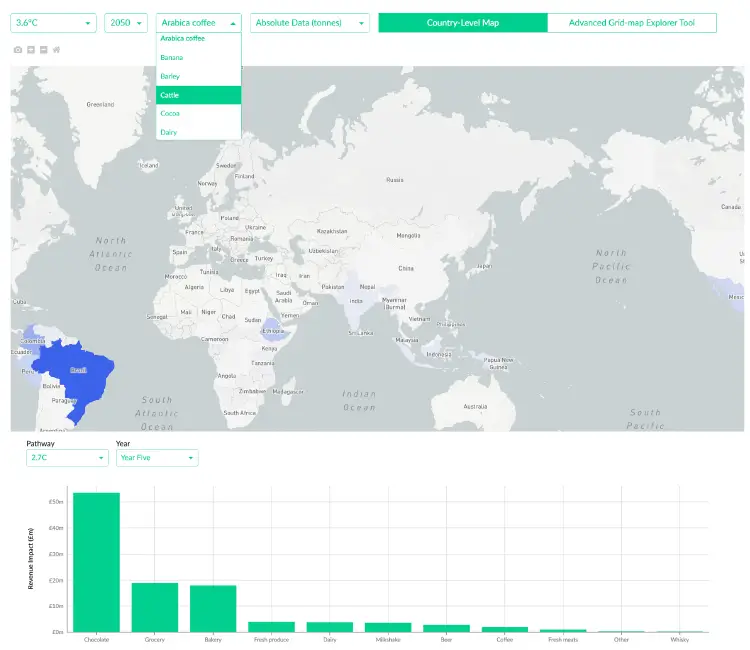
Riise pinpoints the specific climate and nature risks threatening key commodities. By modeling changes in yields and linking them to product revenues, Risilience calculates the precise financial value at risk, turning abstract threats into concrete business metrics
Visualize Global Supply Chain Risk
Know where your vulnerabilities are
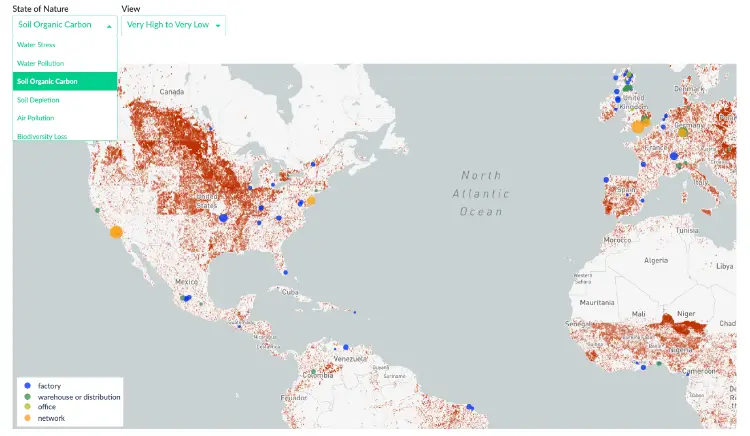
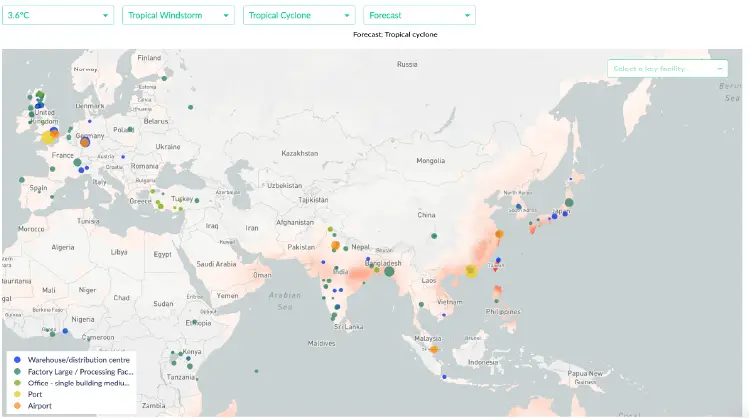
Our platform maps sourcing data, from entire countries down to individual farms, against major growing regions. This provides a line of sight to exposure to risks, including drought, flooding, and biodiversity loss, highlighting where key commodities are likely to be grown in current locations, and what alternative options there are now, and in the future.
Stress-Test Strategy with “What-If” Analysis
Compare the cost of inaction vs investment
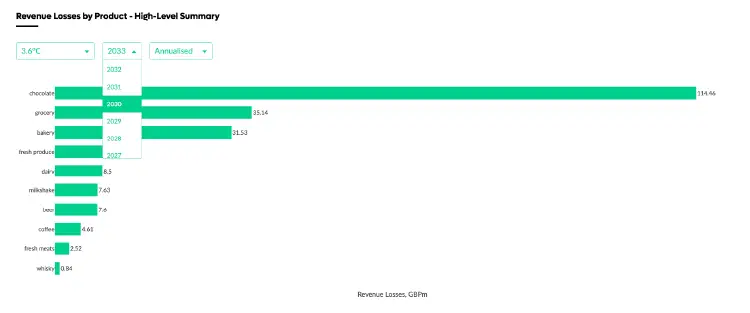
Riise’s powerful scenario analysis enables risk and sourcing teams to explore different strategies. The platform can quantify the financial impact of supply chain disruptions, explore alternative sourcing regions, and cost out mitigation plans to find the optimal path forward across five to 25 year time horizons.
Integrate Climate and Nature for a Complete Picture
Understand the full scope of your organization’s dependency
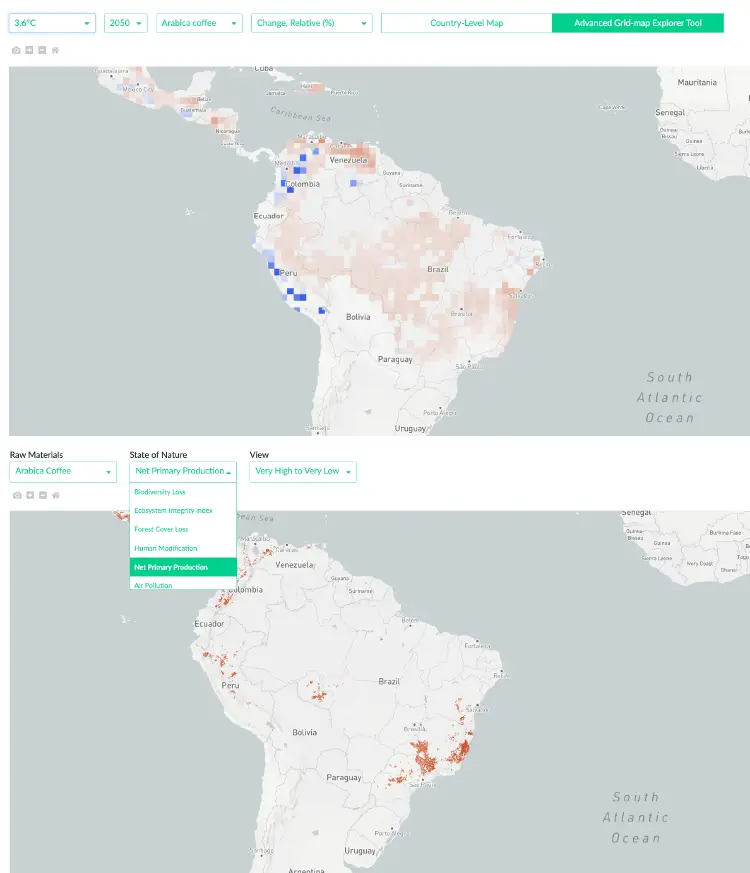
Climate and nature are two sides of the same coin. Our platform’s State of Nature risk layers, including biodiversity intactness, water stress, critical habitats, water pollution, air pollution, soil quality, water basins and forest cover loss, are aligned with leading frameworks and provide a robust foundation for assessing dependencies, impacts, risks, and opportunities across the value chain. This holistic view manages climate risk while building true, long-term operational resilience.
Model End-to-End Disruption
Manage farm-to-table risk exposure
Beyond raw material yields, Riise models acute risks to specific sourcing hubs, processing plants, and supply chain nodes. This provides a coherent, end-to-end view of risk exposure, protecting supply chain stability and securing revenue streams.
The Competitive Advantage: From Insight to Action
Riise models and compares the strengths of different agricultural sourcing strategies, enabling an organization to build a data-driven blueprint that strengthens the agricultural supply chain, protects profitability, and builds business resilience. In an era of escalating climate volatility, inaction is a liability. Global businesses that understand and manage their unique exposure and develop a costed and actionable strategy to mitigate risks will lead the field. To learn more, book a demo with one of our experts.