

DFS Assesses Climate Resilience Across the Entire Value Chain with Risilience
Download customer story
In 2026, leading British furniture retailer DFS engaged Risilience to carry out a comprehensive assessment of its exposure to climate risk. Read on to learn more.
The Brief
There were two main objectives:
- To gather granular data to support DFS’s regulatory disclosures in line with the TCFD framework
- To assess the resilience of the company’s business model and strategy to varied physical and transition risks across a wide range of possible climate scenarios
DFS operates a complex just-in-time supply chain model, built on a concentrated network of supplier locations and transport hubs. Any disruption to the movement of materials and products across this network could quickly have a significant impact on revenue, so it was important to identify vulnerabilities to climate risk across the entire value chain.
The Approach
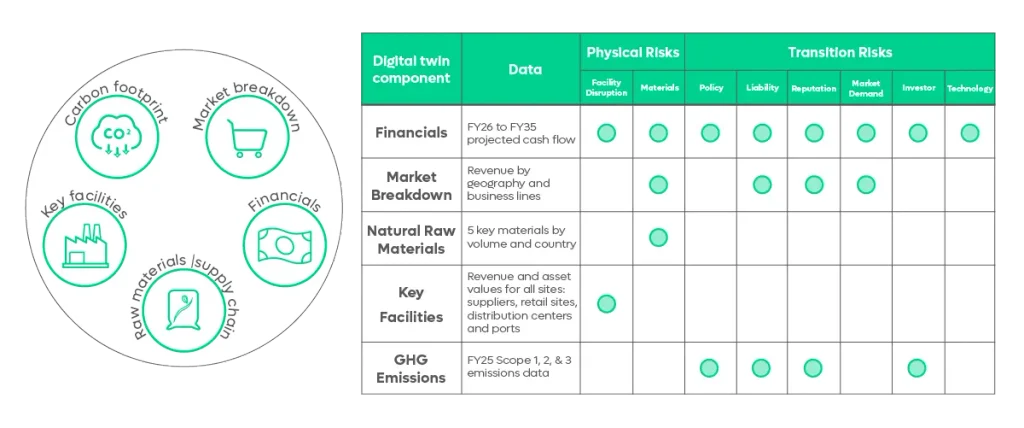
Risilience worked closely with the DFS team to gather relevant data in Riise, the Risilience-powered platform. This data was then used to create a digital twin of DFS’s value chain, including all key manufacturing facilities, as well as ports and other hubs integral to the company’s business model. With this complete, the platform modeled a range of climate scenarios to identify supply chain vulnerabilities and financially quantify potential losses.
Building a Digital Twin for a Comprehensive View of DFS’s Operations
A complete, interconnected representation of DFS’s value chain built on company data.
Financial Quantification of Climate-Related Risks
By directly linking climate pathways to core financial metrics such as cash flows, capital costs, and asset valuations, Riise converts climate scenarios into detailed, company-specific financial forecasts.
Physical risk is quantified as the total revenue impact from sites exposed to climate hazards such as floods and wildfires, as well as revenue at risk due to projected climate-related disruptions.
Transition risk is expressed as the potential loss in a company’s future earnings due to adverse events (earnings value at risk) under different Network for Greening the Financial System (NGFS) emissions pathways.
Insights to Support DFS’s Strategic Decision-Making

Physical Risk
The assessment projected that the financial impact of physical climate risk on DFS will be relatively low across the scenarios and time horizons modelled.
Notably, DFS is most exposed to material supply risk due to yield changes in key raw materials, which could impact product revenue. Specifically, leather is identified as a critical raw material for the company as it is a key component of many DFS furniture products, with supplies concentrated in a small number of regions. By projecting the impact of factors like relative humidity and sunshine hours on cattle production, Risilience was able to predict decreases in leather yields in some of these key locations. However, the decreases are modest, and partly balanced out by increases in other locations.

Transition Risk
The greatest financial impacts to DFS from transition risks are expected to be driven by changes in policy and market demand.
The key policy factor at play is how higher carbon pricing on emissions might add to DFS’s overall costs. In terms of market demand, the assessment projects a potential reduction in revenue due to growing consumer preferences for sustainable products. However, in even the most extreme scenarios analysed, the projected reductions in sectoral and country demand are small.
Business Impact
The results of the Risilience assessment demonstrate that, in spite of its concentrated just-in-time supply chain, DFS faces relatively low exposure to climate-related risks across its value chain. The findings have given the company a strong base of detailed, quantitative evidence to inform conversations with investors, and help secure favorable rates during upcoming refinancing discussions.
Additionally, the analysis highlights possible mitigation strategies DFS can explore to further reduce risk exposure in the future. These include:
- Stress testing alternative supply locations
- Sourcing and testing alternative materials to replace leather
- Stress testing alternative sustainable product initiatives, like the furniture rental model

“After a smooth data-gathering process, the team at Risilience helped us build a detailed understanding of risk across our operations and supply chain. By enabling us to translate that risk into clear financial metrics, they provided insights that will support our regulatory disclosures, while also allowing us to showcase our operational resilience to investors and the market.”
Kate Wright, Sustainability Director, DFS
DFS X RISILIENCE
Download a Copy of the DFS Customer Story
contact
Book a Demo
At Risilience, our mission is to help global organizations to build strategic resilience and grow business value in the era of climate disruption and economic uncertainty.
Book a demo of the award-winning Riise platform with one of our expert consultants.