
How Automotives Can Build Business Resilience and Growth
















Climate and Nature Risk is Business Risk for Automotives
The global automotive industry is navigating a high-stakes transformation, with trillions of dollars in capital investment and legacy assets at risk as the shift to electric vehicles (EVs) accelerates. The pivot from internal combustion engines (ICE) is disrupting traditional business models and reshaping value chains.
Beyond intense competition and tightening emissions regulations, automotive leaders face significant physical risks. Complex, just-in-time supply chains are increasingly vulnerable to disruption from extreme weather events, while the critical minerals required for batteries are often sourced from regions highly exposed to climate-related hazards.
Navigating this new landscape of transition and physical risks requires a data-driven approach to ensure long-term profitability and resilience.
How We Help
The Risilience-powered platform, Riise, and team of specialists support global food and beverage companies to quantify, strategize, and deliver on the financial impacts of climate and nature risks and opportunities, building business resilience and growth.
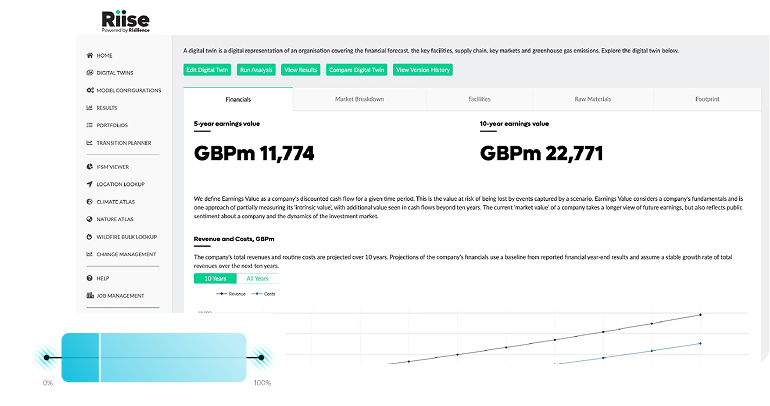
How Risilience Supports Automotives
Riise Solution
Reporting and Disclosure
The Risilience-powered platform, Riise, supports organizations to meet their global sustainability reporting obligations covering physical and transition risks across climate and nature with accuracy, consistency, traceability and credibility.
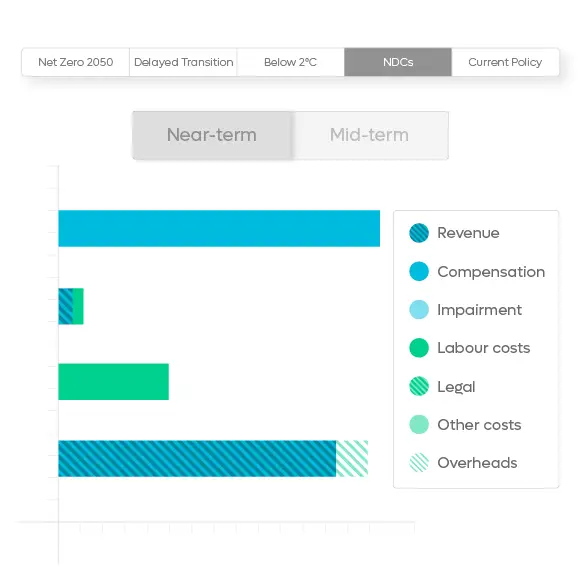
Quantify risks and opportunities from climate and nature-risk using financial metrics that the business understands to move beyond regulatory requirements and drive strategic resilience.
The automotive sector is under increasing scrutiny from regulators and investors. Meeting evolving reporting standards is no longer a tick-box exercise but a strategic imperative.
Riise enables organizations to streamline reporting processes. Our outputs are aligned with global reporting frameworks, including TCFD, CSRD, SB 261 and TNFD, among others, ensuring regulatory readiness and strategic foresight. We help firms to quantify the financial impact of physical and transition risks from climate and nature across the entire value chain, from the sourcing of critical minerals for batteries to manufacturing footprint and downstream operations, providing commercially relevant insights for all stakeholders.Riise delivers improved strategic planning, greater business resilience, aligned financial and sustainability outcomes, and informed, data-driven decision making.
Riise Solution
Strategic Decision Support
In a rapidly changing market, making the right strategic decisions is critical for survival and success. Risilience provides the environmental intelligence and advanced analytics to support confident, future-focused decisions that strengthen long-term resilience and growth.
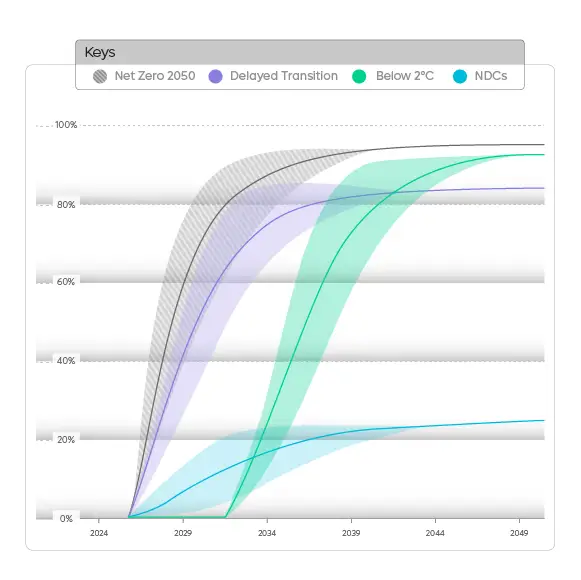
Model multiple climate scenarios to inform future-proof strategic decisions, strengthening long-term resilience to environmental risks.
Our platform enables auto firms to:
- Navigate the EV transition with financial clarity: Use scenario analysis to model the speed and scale of EV adoption and quantify the financial impact of different transition pathways on future earnings.
- Optimize capital allocation: Justify investment strategy by conducting what-if analysis on the company’s portfolio mix (ICE vs. EV), quantifying the ROI of new technologies and manufacturing facilities while managing the risk of stranded assets.
- Build a resilient supply chain: Gain visibility into multi-tiered supply chains to identify and mitigate climate-related risks, from physical risks to critical mineral suppliers to the carbon costs embedded in components.
- Make the business case for transformation: Translate complex climate data and strategic plans into the financial language of the boardroom, to build the business case to justify strategy and demonstrate how transformation will create and protect shareholder value.
Riise Solution
Transition Planning and Insights
A credible and actionable transition plan is essential to capture the opportunities of the low-carbon economy and enhance brand reputation. Risilience supports automotive businesses to develop and implement a robust plan that is integrated with the organization’s business strategy.
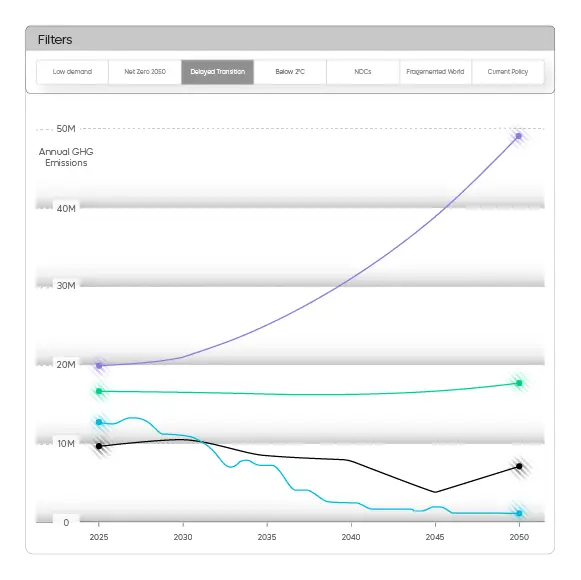
Risilience forecasts emissions to stress test transition plans under different emission pathways, providing confidence to hit decarbonization goals.
Our platform enables auto firms to:
- Create a data-driven decarbonization roadmap: Forecast the company’s GHG emissions trajectories to 2050, stress-testing them against a range of emission pathways and decarbonization levers.
- Optimize decarbonization initiatives: Use Marginal Abatement Cost Curves (MACCs) to prioritize emission reduction initiatives from energy-intensive manufacturing processes to upstream supply chain, based on cost, feasibility, and impact.
- Engage suppliers in decarbonization: Assess the upstream cost of carbon within the company’s supply chain and build a powerful, data-driven business case for supplier engagement and co-investment in decarbonization.
- Unlock new revenue streams: Identify and evaluate opportunities in the emerging EV ecosystem, such as battery-as-a-service, vehicle-to-grid applications, and circular economy models for battery recycling and reuse.
Don’t Just Take Our Word for It

With Risilience as a partner, we saw the opportunity not only to model the CapEx and OpEx cost of climate initiatives, but also factor those insights into future performance against a range of different emission scenarios, which started to make us think about how we could use and replicate this approach across different parts of the business.
Liam Goucher
Climate Transition Manager
National Grid
Ready to Learn More?
contact
Book a Demo
At Risilience, our mission is to help global organizations to build strategic resilience and grow business value in the era of climate disruption and economic uncertainty.
Book a demo of the award-winning Riise platform with one of our expert consultants.